Swarm Research / AI Agent Simulation

Digital Sandbox Engine for
Future Prediction

Upload any seed material, and millions of AI agents evolve freely in a parallel world, finally giving you a detailed deduction report. It turns the eternal question of "What if..." into an experiment that can be run in code.

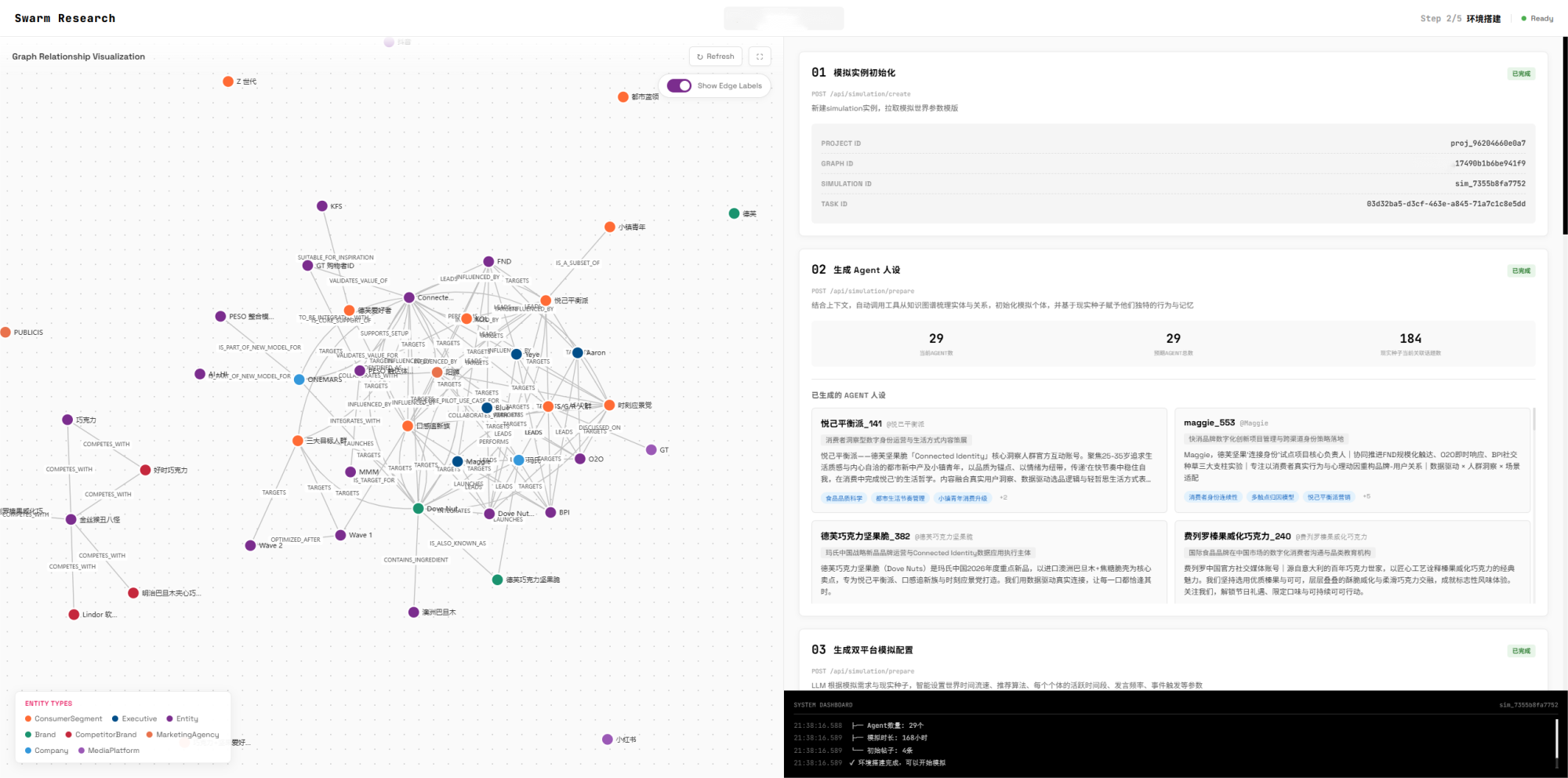
Swarm Research dashboard visualization

Redefining Predictive Science

By building high-fidelity parallel digital worlds, let the future happen in code ahead of time.

Core Methodology: Observing Evolutionary Trajectories

Let things happen in the digital world, observe the actual evolutionary trajectory

Thousands of AI agents with independent personalities, long-term memory, and behavioral logic interact freely in a simulated social platform. Posting, commenting, forwarding, arguing, forming alliances. Users observe public opinion evolution from a "God's eye view" and obtain structured prediction reports.

Parallel Digital World

The Core Form of Swarm Research

Derived from digital twins, not only replicating physical entity states but also building a virtual social system capable of autonomous evolution and intervention experiments.

Executable Social System Copy

Emergence of Complex Social Dynamics

Capturing phenomena such as information cascades, group polarization, and the rise of opinion leaders, faithfully reproduced in multi-agent interaction simulations.

Million-Level Concurrent Simulation

Computational Basis for Macro Social Prediction

Supports concurrent social simulation of up to one million agents, allowing the system to simulate the social network dynamics of a medium-sized city simultaneously.

From Biological Inspiration to High-Order Cognitive Intelligence

Swarm Research applies the biological swarm intelligence paradigm to social prediction, achieving a key innovation from "simple rules emerging complex behaviors" to "cognitive agents emerging social intelligence".

Ant Colony Foraging

Mechanism

Pheromone indirect communication, positive feedback path reinforcement

Computing

Ant Colony Optimization (ACO), solving combinatorial optimization

Bird Flocking

Mechanism

Separation-Alignment-Cohesion three local rules

Computing

Computer graphics, crowd animation

Bee Colony Decision

Mechanism

Scout bee exploration, waggle dance information integration

Computing

Distributed decision making, consensus formation mechanism

Fish School Evasion

Mechanism

Local perception, rapid coordinated turning

Computing

Swarm robotics, autonomous driving coordination

Strong Agent Swarm Intelligence

Breaking the Black Box, Revealing How Predictions Are Formed

When single AI prediction accuracy might be only 30%, through information aggregation, opinion debate, and evidence weighing among agents, the accuracy of group decision-making can be significantly improved.

  • Tracking opinion evolution of key opinion leaders
  • Identifying trigger nodes of information cascades
  • Quantifying the reinforcement effect of echo chambers
Predictive reliability
Lower variance, stronger consensus signal
Δ uplift
+ consensus
Single AI (30%)
30%
High variance
σ ↑
Mean
Confidence band
Single-shot prediction is unstable and sensitive to prompt variance.
Swarm Consensus
85%
Low variance
σ ↓
Mean
Confidence band
Debate → evidence weighing → convergence into a stable, explainable macro outcome.

Emergence

Properties exhibited by the system as a whole that cannot be simply deduced from individual rules. This "undesignable but observable" characteristic is the key advantage of swarm intelligence prediction over traditional statistical models.

Micro: Simple Decision Rules

Adaptive interactions of each agent produce unpredictable patterns

Personality SettingsLong-term Memory StateLocal Information PerceptionBasic Social Actions

Macro Pattern Emergence

macro
Public Opinion Wave

Topic explosion triggered by information cascades

Opinion Polarization

Camp opposition caused by echo chamber effects

Alliance Formation

Spontaneous collaboration brought by convergence of interests

Step 1: Parallel World Building

From Unstructured Text to
Interpretablerit Knowledge Graph

The quality of seed materials determines the fidelity of simulation. GraphRAG empowers AI with "logical reasoning" capability by constructing an entity-relationship-attribute knowledge graph.

News Reports

Situation analysis typical materials, including event background, timeline, multiple perspectives and communication data.

Policy Documents

Macro-environment constraints, defining the rules and regulatory boundaries of simulation.

Story Chapters

Complex interpersonal relationships and social context extraction for deep social simulation.

Academic Papers

Expertise domain knowledge injection, ensuring scientific validity and logical rigor.

GraphRAG Core Advantages

Traditional RAG

Split documents into text chunks, match based on semantic similarity.
Fails to handle complex logical relationships across passages

GraphRAG

Build symbolic knowledge graphs, supporting relationship reasoning.
Enables <b>A</b> to support <b>B</b>, <b>B</b> to oppose <b>C</b>, <b>A</b> may indirectly oppose <b>C</b>

Marketing Ontology Should Be Extended

Ontology
Entity: Brand/Product
Brand personality, product lines, functional attributes
Relation: Brand-Consumer relationship
Cognition, emotional connection, behavioral intention
Entity: Consumer Groups
Fine-grained tags, Personas, user portraits
Relation: Consumer-Consumer relationship
Social influence, reference group impact, word-of-mouth transmission
Entity: Market Environment
Competitors, channels, cultural trends
Relation: Event-Brand relationship
Causality, temporal sequence, emotional shifts
Entity: Key Opinion Points
Advertising, spokespersons, usage experience
Relation: KOP-Decision relationship
Trigger, reinforcement, reversal
Step 2: Temporal Grounded Evolution

Temporal Grounded SearchNot just recall, but the pulse of history

On the basis of traditional knowledge graph, adding temporal dimension enables AI to distinguish "past concepts" from "current information", simulating the real cognitive process of updating knowledge and changing attitudes.

  • Temporal Tagging

    For each fact triple, add a valid time range

  • Change Event Detection

    Automatically detect entity creation, destruction, attribute changes

  • Historical Reasoning

    "Since A supported B last week, but now B fell into controversy, how will A respond?"

T-1 (Last Week)
X supports Y
T-0 (Now)
Y enters controversy
T+1 (Predicted)
X ? (disappointed / indifferent / defending)
Timeline Knowledge Graph
Step 3: Research Query Definition

Define a SMART Research Question

The system automatically analyzes user questions through large language models, extracting research prediction objectives, constraints, and success criteria.

SSpecificClear and unambiguous scope
MMeasurableMeasurable success criteria
AAchievableFeasible given constraints
RRelevantAligned with the decision to make
TTime-boundExplicit time window
Bad Query
"How will NeuroRing's market reception be?"
Too vague, lacks evaluation criteria
Good Query (SMART)
"Within 90 days after NeuroRing's launch, among tech-savvy early adopters, what will be the purchase intention conversion rate?"
Clear boundariesSpecific populationQuantitative Metrics
Step 4: World Building & Evolution

Batch Generate Heterogeneous Agents & Init Environment

The system automatically builds highly complex simulated societies based on graph content, without manual rule configuration.

Demographics

Description
Age, gender, income, region
Generation Basis
Market Research / Census

Psychographics

Description
Openness, risk appetite, motivation
Generation Basis
Psychological Scales

Cognitive Biases

Description
Confirmation bias, herd mentality
Generation Basis
Behavioral Economics

Knowledge & Memory

Description
Existing perception of brands/events
Generation Basis
Historical PR / Brand Assets

Emotional State

Description
Current level of anxiety, excitement
Generation Basis
Social Media Sentiment

Social Network Position

Description
Centrality, connections, influence
Generation Basis
Network Topology Analysis
Step 5: Simulated Communities

Simulated Communities

Agents are deployed into digital platforms that highly restore real-world features, each with unique algorithms.

Public Square (Algo-driven)
Twitter / TikTok
Private Circles (Interest-driven)
Discord / WhatsApp Groups
Deep Content Community
Reddit / Quora
E-commerce Reviews
Amazon / Shopify

Single Evolution Cycle

1
Info Injection
Seed info occurs as an "event"
2
Individual Reaction
Evaluate info, update memory
3
Social Interaction
Post, share, comment or stay silent
4
Network Update
Relations reorganize, algorithms recalc
High TransparencyEvolution is not a black box; every step is traceable
Step 6: Simulation Parameters

Simulation Parameters

Adjust time and scale to fit different business needs.

Time Span Setting

Short Burst1-10 Rounds
PR crisis 24h, launch event reaction
Hallucination Risk: Very Low
Short-term Ferment10-30 Rounds
New product first week
Hallucination Risk: Low
Mid-term Evolution30-100 Rounds
Brand rebranding, policy adaptation
Hallucination Risk: Medium
Long-term Shift100+ Rounds
Cultural trend shifts, category edu
Hallucination Risk: High

Sandbox Scale

RECOMMENDED
Focus Group(10-50 Agents)
Deep qualitative, concept validation
Est. Tokens
10K - 100K
Tribe Sim(100-500 Agents)
Subculture conflict, Niche testing
Est. Tokens
500K - 2M
Town Level(1,000-5,000 Agents)
Mainstream promo, cross-circle analysis
Est. Tokens
5M - 20M
City Level(10,000+ Agents)
Macro PR prediction, stress testing
Est. Tokens
50M+

Economies of Scale Trade-off Larger scale doesn't always mean linear accuracy gain. Research shows macro emergence stabilizes around 5,000 agents. Start small.

Step 7: Evolution Starts

Evolution Starts

System engine starts, multi-model collaboration ensures realism.

Voice

  • Proactive posting
  • Reply to others
  • Cross-platform relay

Stance

  • Like / Dislike
  • Voting
  • Emoji reactions

Relations

  • Follow new nodes
  • Unfollow / Block
  • Join sub-groups

Decision

  • Purchase intent
  • Brand preference reversal
  • Join boycotts

Underlying Models

Actor ModelCore

Drives agent thought and behavior, requires high logic and role-play capability.

Environment Model

Simulates platform algorithms and physical world feedback.

Observer Model

Silently records interactions, performs real-time data aggregation.

Memory & Context

Hybrid memory architecture to solve context forgetting in long simulations.

Working MemoryCurrent round stimuli
Short-term MemoryRecent hot events
Long-term MemoryValues retrieved via vector DB
Memory ReshapingCognitive changes from major events
Step 8: Analysis & Insights

From "Data" to "Actionable Strategy"

ReportAgent has privileges to access global sim data. It transforms millions of micro-interactions into understandable macro patterns.

Step 01

Data Aggregation

Aggregate individual interactions into explainable patterns

Step 02

Scenario Recognition

Identify typical evolution paths and key turning points

Step 03

Anomaly Detection

Mark outlier scenarios and analyze implications

Step 04

Comparative Analysis

Compare outcomes under different intervention conditions

Standardized Report

Standardized Template
Executive SummaryKey findings & recommendations
Markdown
Macro Trend ChartsHeat, sentiment, camp timelines
Charts
Key Node NetworkCore hubs of information spread
Graph
Micro Mindset ShiftSample agent thought chains
Logs
Stress Test ResultsSystem performance in extremes
Table
Intervention StrategyBest action plans based on sim
Action List
Sample Logs
Micro interactions condensed into a readable timeline.
25 logs
Time
Event
Signal
T+00:00
Agent 01 · Viewed seed content
PositiveLow · 62%
T+00:37
Agent 02 · Liked a post
NeutralMedium · 73%
T+01:14
Agent 03 · Left a comment
NegativeMedium · 84%
T+01:51
Agent 04 · Shared to network
PositiveLow · 62%
T+02:28
Agent 05 · Followed an influencer
NeutralMedium · 73%
T+03:05
Agent 06 · Stayed silent
NegativeMedium · 84%
T+03:42
Agent 07 · Updated belief
PositiveLow · 62%
T+04:19
Agent 08 · Shifted camp stance
NeutralMedium · 73%
T+04:56
Agent 09 · Viewed seed content
NegativeMedium · 84%
T+05:33
Agent 10 · Liked a post
PositiveLow · 62%
T+06:10
Agent 11 · Left a comment
NeutralMedium · 73%
T+06:47
Agent 12 · Shared to network
NegativeMedium · 84%
T+07:24
Agent 01 · Followed an influencer
PositiveLow · 62%
T+07:01
Agent 02 · Stayed silent
NeutralMedium · 73%
T+08:38
Agent 03 · Updated belief
NegativeMedium · 84%
T+09:15
Agent 04 · Shifted camp stance
PositiveLow · 62%
T+09:52
Agent 05 · Viewed seed content
NeutralMedium · 73%
T+10:29
Agent 06 · Liked a post
NegativeMedium · 84%
T+10:06
Agent 07 · Left a comment
PositiveLow · 62%
T+11:43
Agent 08 · Shared to network
NeutralMedium · 73%
T+12:20
Agent 09 · Followed an influencer
NegativeMedium · 84%
T+12:57
Agent 10 · Stayed silent
PositiveLow · 62%
T+13:34
Agent 11 · Updated belief
NeutralMedium · 73%
T+13:11
Agent 12 · Shifted camp stance
NegativeMedium · 84%
T+14:48
Agent 01 · Viewed seed content
PositiveLow · 62%

Multi-dimensional Analysis

Unlike traditional single-perspective analysis, ReportAgent navigates freely between micro motivations and macro trends.

Macro Trend Layer

Charts

Topic lifecycle, sentiment polarization

Meso Structure Layer

Topology

Community tears, echo chamber boundaries

Micro Motive Layer

Causality

What arguments persuaded the stubborn?

Counterfactual Layer

Matrix

What if published a day later?

Opinion Evolution Sim

Early Adopter Spread
Opposition Echo Chamber
Cross-circle Breakthrough

Identify Key Nodes in the Network

Not all nodes are equal. Intervening with a few key nodes yields outsized results.

Info Hubs

Method

Highest betweenness centrality

Value

Accelerate cross-circle spread

Emotional Triggers

Method

Highly susceptible & contagious

Value

Prevent PR crises

Bridges

Method

Weak ties between opposing camps

Value

Break echo chambers, build consensus

Silent Majority

Method

Low interaction but easily influenced

Value

Decides the final public opinion

See your next decision before it happens

Tell us your scenario. We’ll show the workflow and a sample report for your brand.